
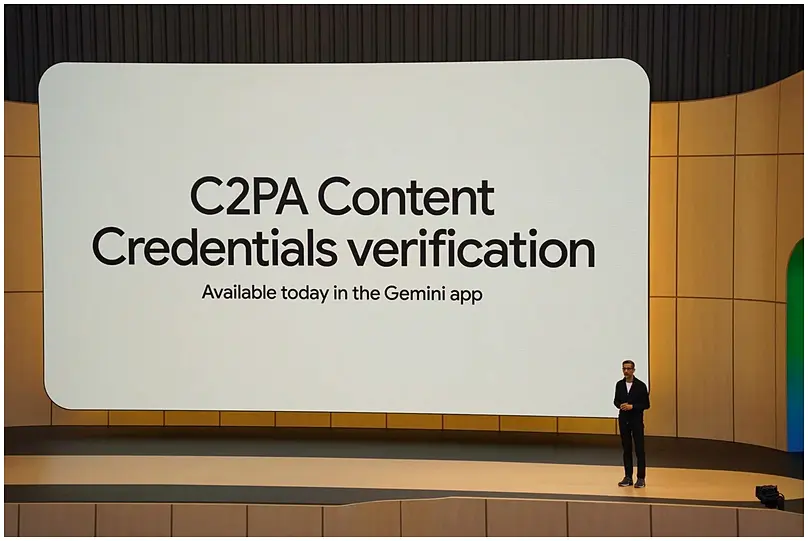
The digital world’s battle against AI-generated deception just got its biggest test yet. We’re talking about a massive push to make identifying deepfakes and other AI-created content simpler, almost automatic. Two key technologies, SynthID and C2PA Content Credentials, are expanding their reach dramatically. This isn’t just an upgrade; it’s a make-or-break moment for turning the tide against the deluge of unlabeled AI fakery online.
Yesterday, at its I/O conference, Google dropped a bombshell. Soon, Chrome and Search will verify images for SynthID markers. This isn't small potatoes. Chrome owns the browser market. Search? Same story. This means AI verification tools will be shoved in front of billions of eyes. And the process? Streamlined. No more uploading images to Gemini just to check for a watermark. A simple click.
But Google didn't stop there. Their verification interfaces will also scan for C2PA information. This provenance metadata, embedded at creation, tells you how content was made. If AI touched it. Users can now check both labels from one spot. No more app-hopping.
This kind of cooperation? Long overdue. Both Google and the Content Authenticity Initiative (CAI), C2PA’s biggest cheerleader, echo the same sentiment: everyone needs to get on board. More AI models must embed this data. Online platforms, where fake content thrives, need to display it clearly. Browser-level tools might even bypass reluctant websites. Ingenious.
Then OpenAI stepped in. They announced yesterday they'll embed SynthID into images from ChatGPT, Codex, and their API. OpenAI already uses C2PA metadata, but it often disappears. Stripped out. The company itself has tried to temper expectations about C2PA, despite being a steering member. A curious position.
"Metadata like C2PA is not a silver bullet to address issues of provenance. It can easily be removed either accidentally or intentionally. For example, most social media platforms today remove metadata from uploaded images, and actions like taking a screenshot can also remove it. Therefore, an image lacking this metadata may or may not have been generated with ChatGPT or our API."
The Fragile Nature of Digital Trust
That statement, from OpenAI’s own C2PA help page before its recent update, makes one wonder. A "silver bullet"? Hardly. Yet, C2PA is touted as the industry standard. Pitched to governments as the solution for AI transparency. Despite growing adoption by AI, hardware, and software companies, I seldom see it actually work. SynthID, by comparison, seems more resilient. It’s not easily removed. Its reach is limited, sure, but I recall instances where fact-checkers used it to debunk deepfakes. It worked.
A wider net is needed. Both C2PA and SynthID can contribute. This isn't a competition that benefits anyone. But Google now has a chance to prove its system is superior. To snatch some of C2PA's spotlight. C2PA, in turn, must prove its worth.
The opportunity’s here. Google announced Meta will use C2PA metadata on Instagram. For camera-captured images. No word from Meta yet on details, but picture this: "Captured on Pixel 10." Like "Sent from my iPhone." This could help users spot the "real" photos. Instagram head Adam Mosseri wants us to stop "assuming what we see is real by default." A noble goal.
If labeling even works. Instagram already checks for C2PA. Yet, previous attempts to label AI-generated content have backfired. Photographers claimed their images were wrongly tagged. Embarrassing.
Let's not shower Google with praise just yet. They preach AI transparency, fight deepfakes, all while building the very tech used to deceive. Supplier and solution. A convenient position. If SynthID truly makes a dent, then maybe. But my hopes? Low. The problem’s just too big. Open-source models, the true creators of nefarious deepfakes, won't likely line up to adopt these systems. Provenance was never a perfect fix. Now, Google and C2PA must prove it’s not a complete waste of time. A heavy lift, indeed.



No comments yet. Be the first to share your thoughts!