
Eric Schmidt, Google’s former CEO, faced a chorus of boos at a recent commencement speech. His topic? Artificial intelligence. A sign of profound student anxiety, perhaps, or plain ambivalence regarding AI’s relentless march into daily life. The message, it seems, utterly bypassed Google’s Mountain View campus.
Just days later, at the company’s annual I/O developer conference, AI wasn't just a focus; it was the focus. Two hours of keynote presentations, executives gushing over nothing else. Google unveiled a startling array of new ways AI will weave itself even deeper into their colossal product family—from Search and Gmail to productivity suites and, yes, smart glasses.
Sundar Pichai, the man at Alphabet's helm, kicked off the event. He lauded AI's power, citing its help for students prepping exams, its ability to free artists into their "creative flow." This, he declared, is the "agentic AI era." Bold words. And the company's actions certainly back them up.
The New Face of Search & Billions on the Line
In perhaps the most visible shift for the $4.7 trillion behemoth, Google announced a redesign of its iconic, sparse, all-white homepage. That ubiquitous search box? It's getting bigger. Why? To better swallow the natural language queries AI now allows. Users will soon enlist AI "agents" for complex, ongoing research—custom reports on everything from apartment hunts to the latest financial news. A fundamental redefinition of how we interact with information.
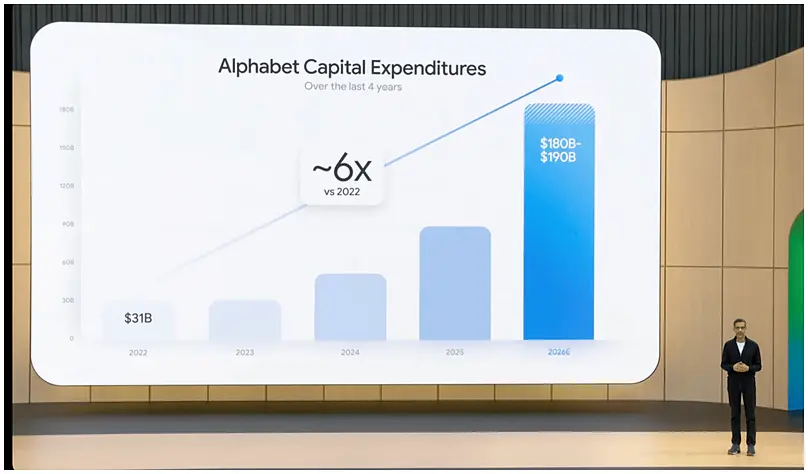
The company plans to spend between $180 billion and $190 billion this year on AI infrastructure, a staggering leap from $31 billion in 2022. Wall Street, naturally, has questions.
Pichai didn’t shy away from the dizzying sums involved. He touted the sheer capital being poured into AI infrastructure. And the "tokens." These are the basic units of AI data processing, and they’re being gobbled up at an astonishing rate. Google now chews through 3.2 quadrillion tokens every month. Just one year ago, that figure sat at 480 trillion. A parabolic surge. Capital expenditures—a genuine concern for some on Wall Street—flashed on a giant screen behind Pichai. The plan: a projected $180 billion to $190 billion this year, dwarfing 2022's $31 billion.
"We are taking a differentiated full stack approach to AI innovation," Pichai asserted. "From our custom silicon and secure foundation to our world class research and models to our products and platforms that reach billions of people." Lofty ambitions, backed by very real, very large checks.
Intelligent Eyewear and the AI Arms Race
Come fall, Google's "intelligent eyewear" will debut. AI-enabled, audio-equipped glasses. While full display smart glasses remain a future promise, these initial models—built with Samsung, Warby Parker, and Gentle Monster—will let users manage appointments, get directions, and check emails just by listening and speaking. A low-key entry into a high-stakes market.
Shares of Google dipped roughly 2% Tuesday. A broader market sell-off was certainly a factor, but the underlying tension is palpable. Google is locked in a ferocious AI arms race. OpenAI, Anthropic, Meta, Microsoft—everyone’s spending billions to grab the lead. Google, initially caught off-guard by OpenAI’s generative AI revolution in late 2022, has sprinted to catch up. Their Gemini large language models now position them firmly in the frontrunner pack.
I/O showcased new Gemini 3.5 models. And a multimodal "Gemini Omni" system. It can generate video from mixed inputs: text, images, audio, video. The company’s AI Overviews now reach over 2.5 billion users. The Gemini app? 900 million monthly active users. This is how Google leverages its gargantuan existing ecosystem—to distribute new AI capabilities globally, at scale. Pichai proudly noted 13 Google products boast over a billion users each. Five products exceed three billion. A captive audience for new tech.
Beyond the headline models, granular innovations abounded. "Gemini Spark" emerged, a "persistent agent." This isn’t a one-and-done chatbot; it keeps working, retaining context across Gmail, Docs, Chrome. Then there's "Docs Live," a voice-driven document creation tool. And "Ask YouTube," a conversational feature that digs into specific video moments for answers. Even shopping gets an AI overhaul with a "Universal Cart" for cross-merchant purchases, alongside new protocols allowing AI agents to securely buy on your behalf. Further updates to the Antigravity AI coding platform, AI-generated visuals in Search, and conversational AI throughout Maps, Gmail, YouTube were also previewed. The message is clear: AI isn’t just integrated. It is Google.
But amidst the dazzling demos and eye-popping expenditure, one has to wonder if student boos in a university hall are merely a fleeting echo against the corporate drumbeat, or a whisper of future anxieties yet to fully materialize.



No comments yet. Be the first to share your thoughts!