
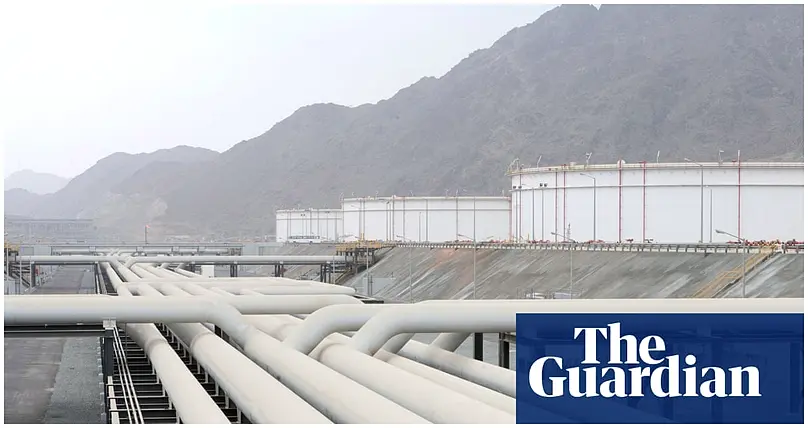
The United Arab Emirates isn't waiting around. Not for peace. Not for guarantees. With the Strait of Hormuz effectively choked off, Abu Dhabi has fast-tracked a massive new oil pipeline, a brazen bid to secure its future crude exports and, perhaps, reshape regional power dynamics.
This isn't just about business; it’s about survival in a volatile neighborhood. The current blockade of that critical waterway — once the conduit for 20% of the world's seaborne oil and gas — approaches its third month. Global energy prices? Sky-high. Gulf economies? Gasping.
Sheikh Khaled bin Mohamed bin Zayed Al Nahyan, Abu Dhabi’s crown prince, personally ordered the acceleration of this previously under-wraps project. The directive: Get oil flowing from the emirates to the port of Fujairah by 2027. Fast. This new conduit is expected to double the UAE’s existing export capability, taking its bypass capacity to a potential 3.6 million barrels a day. Suddenly, the country has options. Big options.
Beyond the Strait: A Bold Stroke
The existing Habshan-Fujairah pipeline, capable of moving 1.8 million barrels daily, has already proven its worth. It kept UAE oil flowing even after Iran sealed off Hormuz following the US and Israel’s strikes back in February 28. Only the UAE and Saudi Arabia possess such escape routes, pipelines that deliver crude outside that narrow, contested stretch between Iranian and Omani territory.
"This isn't merely an infrastructure project. It's a loud declaration of independence from a choking point, and a clear signal that Abu Dhabi plans to write its own rules in the global energy market."
This pipeline push comes just weeks after the UAE sensationally exited OPEC, its membership spanning six decades. A schism, many called it, with Saudi Arabia, the cartel's de facto leader, laid bare. Leaving the group was already interpreted as a move to pump more oil than future OPEC quotas might allow, whenever the current conflict finally winds down. Now, with a new pipeline, Abu Dhabi can pursue its ambitious export goals, even if the regional tensions drag on, or if any eventual peace deal fails to fully restore free passage through Hormuz.
The long-simmering friction between Abu Dhabi and Riyadh has finally boiled over. The Saudis, typically, prefer tight production quotas. Keep prices high, support their vast economic ambitions. The UAE? It’s charting a different course, prioritizing strategic flexibility over cartel unity.
While the exact capacity remains undisclosed, a doubling of the current 1.8 million barrels per day would bring the UAE’s independent pipeline exports into a league closer to Saudi Arabia's. The Kingdom can shunt roughly 7 million barrels daily from its eastern fields to the Red Sea port of Yanbu, with 5 million earmarked for export. The UAE, it seems, aims to catch up, or at least, insulate itself completely.
A new pipeline, a new strategy. The game is changing in the Gulf. And the UAE is making sure it has a way out, whatever comes next.


Great article