
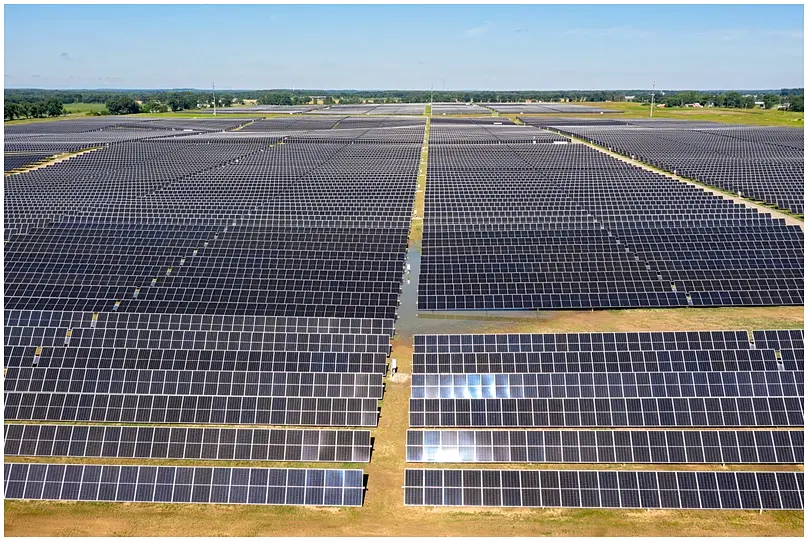
A $67 billion bet on the future. That’s what NextEra Energy just dropped, announcing a colossal acquisition of Virginia-based Dominion. This isn't merely a merger; it’s a direct play to dominate the burgeoning AI data center industry, a sector ravenous for electricity, demanding power unlike anything seen in decades. NextEra, it seems, intends to build the world’s largest utility to meet that insatiable appetite.
The deal, unveiled May 18, is a gamble. A hefty premium was paid. Was it too much? Investors certainly had their doubts, with NextEra's stock dipping almost 5% on the news, even as Dominion's soared 9%. The market, it appears, worries about overpaying in an already inflated utility sector, a sector buoyed by the very AI boom NextEra aims to capture.
NextEra Chairman and CEO John Ketchum isn't blinking. He's framing this as an absolute necessity. Scale. That's the word. He argued passionately on an analyst call that only a titan of this magnitude could possibly satisfy the “enormous and fast-growing demand” from hyperscalers, the surge in electrification, and plain old population growth. Rapid construction? Affordable power? Only with this kind of muscle, he insists.
Consider the raw numbers. The combined construction backlog? A staggering 130 gigawatts. More than their current generation. That's enough juice for 100 million homes. Out of roughly 150 million across the entire U.S. Think about that.
"Our country is at an inflection point. The demand for electricity is increasing unlike anything we’ve seen in generations. Practically every corner of America needs power solutions, not someday, but right now."
Ketchum had hinted at this ambition earlier this spring to Fortune. His desire? To make NextEra the undeniable leader in building those massive data center and AI factory hubs nationwide. Scale, he declared then, was the sole path to affordable growth. The only way to sidestep the looming "AI affordability backlash" already rippling across the nation.
This all-stock transaction stands as the largest energy acquisition of this century. Indeed, you'd have to rewind to Exxon's Mobil takeover in 1998 to find anything comparable. If it closes, NextEra would become the third-biggest U.S. energy company by enterprise value, a colossal $420 billion, trailing only Exxon Mobil and Chevron. Big company. Bigger ambitions.
Dominion isn't just a casualty of a market frenzy. Its value had climbed steadily since late 2023. The deal gives NextEra, already the U.S. power and utility market cap leader, a formidable regulated utility presence in Virginia—a state infamous for its "data center alley"—and the growing Carolinas. This merges NextEra’s sprawling Florida Power & Light operations and its presence in 44 states with Dominion’s strategic footprint. A truly national player emerges. The biggest utility globally. The largest renewable energy and battery storage developer. U.S. leader in total power and gas-fired generation. Second in nuclear. Comprehensive. Unrivaled.
"We are the only ones out there really building across the United States," Ketchum asserted. "We are a builder at our heart." This philosophy underpins the entire strategy. Winning the AI energy game, he contends, hinges on nationwide scale. Developing data center hubs. Working with communities. All without hiking customer utility bills. A tricky balance, to say the least.
The Hyperscale Conundrum: Who Pays for Power?
The "not in my backyard" pushback is real. Ketchum acknowledged it. But once you "plant a flag," he argued, expansion gets easier. Local politics, water resources, land access—these are formidable hurdles. And the solution? Twofold. First, hyperscalers must fund their own generation. "Build your own power," he demanded. Second, NextEra needs the scale and capital to grow with them. It’s a partnership, but one where NextEra sets the terms.
A single data center campus can gulp down a gigawatt of power. That’s enough for three-quarters of a million homes. Some plan for five gigawatts or more. The company's expertise aims to offer every solution: solar and batteries for initial rollout, then gas-fired power for expansion, eventually nuclear. A tiered approach. Prudent.
NextEra isn't new to this. They built a massive gas-fired fleet in Florida. For two decades, they led in renewables construction nationwide, even when U.S. power demand mostly flatlined. Back then, customers needed smaller, incremental solutions: a 100-megawatt wind farm, maybe 40 megawatts of batteries. "Just enough," Ketchum explained, "to accommodate the increased demand they were seeing." That experience, that scaling with renewables and storage, transformed their business beyond Florida. Now, the paradigm has shifted.
"The paradigm has changed to serve the hyperscaler," Ketchum stated in that prior interview. Today's solutions demand a mix: renewables, batteries, gas power, gas transmission, nuclear. All assembled fast. All assembled cheaply. "Our approach is very pragmatic rather than ideological," he emphasized. "What does a customer want?" Complex hubs, he posited, often require "putting all the different pieces together."
NextEra already boasts over 30 potential data center campuses across the U.S., eyeing 40 by year's end. This portfolio gives them leverage. They can offer not just solutions, but sometimes better ideas than the customers initially envision. Ten gigawatts for two major hubs in Texas and Pennsylvania, co-owned by the U.S. and Japanese governments? That's just the start.
"We can say, 'Well, here’s why we think you’re wrong,'" Ketchum quipped. "Here are the areas that you should be looking at because they have better water resource, better gas pipeline access, better transmission access, the ability to expand 5 gigawatts because of land positions." Informed decisions, he insists, lead to more advanced buildouts. They're not just selling electrons; they're selling strategy.
Their projects are diverse. Reopening Iowa's Duane Arnold nuclear plant for Google. Developing 2.5 gigawatts of solar and battery for Meta in Texas and New Mexico. Dominion, for its part, is finally completing the Coastal Virginia Offshore Wind project, despite earlier Trump administration opposition. The wheels are turning. Everywhere.
The all-stock deal won't close until 2027. NextEra shareholders will hold about 74.5% ownership. Ketchum remains Chairman and CEO. Dominion CEO Robert Blue will head regulated utilities. Dominion’s brand persists in Virginia and the Carolinas. Dual headquarters: Juno Beach, Florida, and Richmond, Virginia. About 10 million customer accounts served. A sprawling empire.
"The stakes couldn’t be any higher," Blue told analysts. Demand screams from "all sectors of the U.S. economy." Meeting this moment requires efficiency: buying, building, financing, operating. "Easier said than done," he admitted. It demands scale. Deep skills. Experience. For NextEra, that means an annual capital spending budget of $59 billion for the foreseeable future. More than any other utility player. By a long shot.
Because ultimately, Ketchum reminds us, they’re selling a commodity. Electricity. "One electron is not distinguished from another other than its price." The goal? To be the low-cost provider. To combine technologies, to deliver what the customer wants, at the most affordable rate. The future of AI, it seems, hinges on who can deliver the cheapest electrons. A simple truth in a complex world. And a monumental challenge.



No comments yet. Be the first to share your thoughts!