
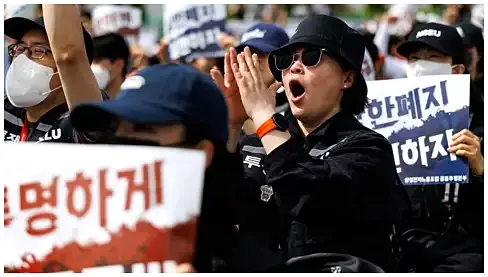
The global tech industry just exhaled. Samsung Electronics, the titan of memory chips, struck a last-minute tentative pay agreement with its largest union, effectively suspending a planned strike that threatened to send shockwaves through the booming artificial intelligence sector.
For now, the disruption fears have receded. This wasn't merely an internal spat; it was a potential wrench in the gears of the world's insatiable demand for AI data centers, a demand Samsung helps satisfy more than almost any other company.
The union, representing nearly 48,000 workers, confirmed industrial action slated for Thursday would be paused. Members will vote on the proposed deal between May 22-27. A critical period for everyone.
The AI Gold Rush and a Pay Divide
At its core, this dispute was about money. Specifically, how to carve up the immense profits generated by the surging demand for AI memory chips. Samsung's operating profit for the January-March quarter, for instance, rocketed an astounding 750% year-on-year. The company's market valuation even breached the $1 trillion mark in May, largely on the back of AI chip excitement.
The sticking point? Bonus distribution. Samsung had envisioned hefty payouts for 27,000 staff making those lucrative memory chips – reportedly six times more than employees crafting other chips and electronics. A vast disparity.
Union officials argued that 23,000 workers producing less advanced chips, components vital to companies like Tesla and Nvidia, shouldn't be left behind. Their contribution, they insisted, was equally essential. It was a fairness argument, pure and simple.
"In today's interconnected global economy, disruptions in strategically important industries can create ripple effects extending well beyond a single company or market."
The specter of a strike loomed large. A walkout at Samsung, the globe's foremost memory chipmaker and a crucial supplier for everything from AI data centers to smartphones, could cripple global supply chains. South Korea, an export-driven economy heavily reliant on the Samsung Group – which accounts for roughly a fifth of its total economic output – faced significant repercussions.
Competitive Pressures and Cautious Truce
This drama played out against a backdrop of fierce competition. Rivals like SK Hynix and Micron are aggressively vying for dominance in the red-hot AI chip market. SK Hynix, in particular, made waves last year by abolishing its bonus pay cap, leading to payouts more than triple those offered at Samsung. Talent, naturally, began to migrate.
Samsung responded. Transcripts of wage negotiations seen by Reuters showed the company proposing memory chip workers receive bonuses equivalent to 607% of their annual salary – even higher than SK Hynix's offering. Yet, workers in other divisions? A mere 50% to 100%. The union, predictably, demanded the bonus cap be scrapped entirely and 15% of annual operating profit be allocated to a company-wide bonus pool.
Company bosses had already warned of a broader hit to South Korea's economy, citing potential losses in sales, investment, and tax revenue. JP Morgan analysts had even pegged the impact on Samsung's operating profit at a staggering 21 trillion to 31 trillion won ($14.08bn to $20.79bn).
The court, too, stepped in. An injunction granted to Samsung Electronics limited any potential walkout, mandating normal staffing levels for safety, facility protection, and product quality. The union faced steep daily fines if it breached the order.
Following the agreement, Samsung’s shares climbed over 8% on Thursday, reflecting market relief. South Korea's Kospi index mirrored the jump. The company, in its post-deal statement, offered a conciliatory note: "With a humble attitude, we will build a more mature and constructive labour-management relationship to ensure that such an incident never happens again."
A good sentiment, no doubt. But in an era where AI demands increasingly stretch global capacities, the balance between corporate ambition and fair compensation remains a razor's edge. This time, a crisis was averted. Next time?

No comments yet. Be the first to share your thoughts!