
Finding the perfect pair of jeans? It demands patience. And a willingness to discard what simply doesn't fit. ThredUp, the secondhand resale giant, built an empire on that very premise: giving items a second chance, offering consumers a guilt-free way to move on.
Turns out, the same logic applies to people. Specifically, employees. James Reinhart, ThredUp's co-founder and CEO, understood this intimately. So, when he observed what happened after his workforce shifted to a four-day week—satisfaction soared, retention solidified, creativity exploded—he didn't second-guess it. A good fit, after all, makes you want to hold onto something.
The Non-Negotiable Shift
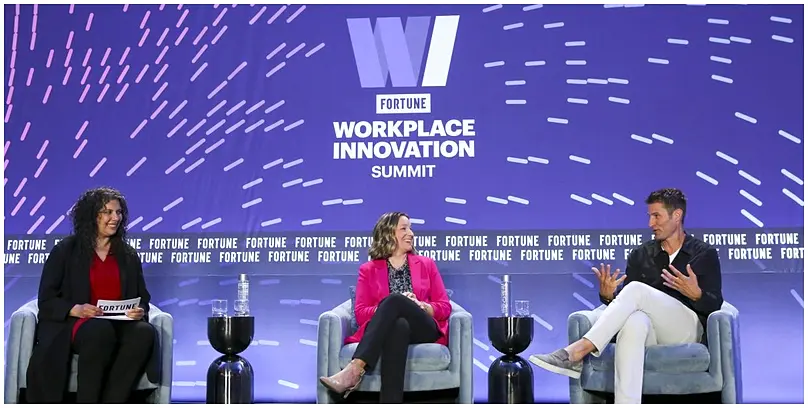
“It was a top-level decision,” Reinhart declared just days ago at Fortune’s Workplace Innovation Summit in Atlanta. The message was unequivocal. “We’re not going back.” This conviction, Reinhart posits, is exactly why ThredUp will outmaneuver competitors still clinging to the five-day grind. They're already attracting top-tier talent. Others? They're just losing.
Reinhart first introduced the shortened week during the pandemic. He saw employees, given autonomy over their schedules, deliver remarkable productivity. Retention metrics, he claimed, went “through the roof.” So, as other companies signaled a return to office mandates, Reinhart dug in. The four-day week became a permanent fixture.
Malissa Clark, a psychology professor at the University of Georgia and author of “Never Not Working,” isn't surprised. Her research aligns perfectly with Reinhart’s observations. Clark pointed to rigorous, psychometric trials conducted globally as part of the four-day work week movement. The companies’ biggest fears? Largely unfounded, it seems.
“All of the well-being metrics were going up, burnout was going down, turnover was going down,” Clark stated. But it wasn't just soft metrics. Companies, naturally, fixate on the bottom line. And here's the kicker: “revenue went up in the majority of these companies, and it’s sustained over time.”
Perhaps most startling, Clark revealed, was employee sentiment. A staggering 96% of trial participants wanted the four-day schedule to continue. An astounding 15% flat-out refused to return to five days, no matter the compensation. “That I thought was shocking,” Clark admitted to the summit attendees.
The AI Advantage
Reinhart’s argument now extends beyond ThredUp’s internal metrics. In a world increasingly shaped by AI, where work paradigms are rapidly evolving, he views the four-day week as the ultimate competitive weapon for securing exceptional talent. Companies stuck in the old model? They face a stark future.
“Those exceptional employees are going to want to work at ThredUp four days a week. And you’re going to be competing against companies like mine for these exceptional people. And you’re going to lose.”
Part of that magnetic pull is simple: how employees feel. “Rested employees and genuinely happy employees are way more creative,” Reinhart explained. “When people come back on Monday morning, they’ve gone on hikes, they’ve spent time with their kids and families. They’re ready to be the best version of themselves.”
No more spending the first four hours of Monday “getting back in the groove and reminding themselves why they still want to work here.”
Clark concurred, but offered a vital distinction: the four-day week isn't about shoehorning 40 hours into four days. It's a genuine reduction to 32 hours, respecting a life beyond the office. “The bottom line with the four-day work week is shaving those eight hours off,” Clark emphasized. Happy minds, she noted, often spark the best ideas during a walk or a shower, not chained to a desk for six consecutive hours.
With work-life balance now a non-negotiable and AI poised to redefine the workplace, Clark sees a singular, positive outcome. “With every technological revolution, there are these predictions,” she mused. “Can we please, for the love of God, implement those predictions, and at least shave off a day?”



No comments yet. Be the first to share your thoughts!