

A peculiar, perhaps desperate, trend has seized Australia's startup community: AI-generated photos of Prime Minister Anthony Albanese. Not as a figurehead of innovation, but rather as an unwelcome, albeit digital, co-founder, complete with a hefty imaginary equity stake. This digital mockery isn't mere jest; it's a pointed protest against the government's proposed changes to capital gains tax (CGT) — changes many fear will cripple the nation’s burgeoning tech sector, or worse, send it packing.
The federal government intends to overhaul the CGT discount, replacing the current 50% tax break on profits with a system of “cost-base indexation” – essentially, taxing profits after accounting for inflation – and a minimum 30% tax rate. For the tech world, especially early-stage startups often cash-strapped, this isn't just a tweak. It's a potential wrecking ball.
Startups frequently lure top talent with equity or stock options, a sweetener in lieu of fatter paychecks. Founders, too, risk everything on the dream of a substantial payday when their venture eventually sells. Both scenarios, fundamental to the startup ecosystem, now face significant headwinds. The Tech Council of Australia didn't mince words, warning that these changes could indeed become collateral damage.
“There is work to do to ensure Australia’s startup community doesn’t become collateral damage as a result of proposed changes,” stated Kate Cornick, the council’s chief executive. Her concern echoes a broader sentiment across the industry.
Jacques Greeff, founder of the communications app Kinso, shared AI images of Albanese seemingly coding alongside his team, wryly noting, “He’s having a great time with his new 47% equity.” Greeff told Guardian Australia the incentive to grow a business, with all its inherent risks, is now “greatly reduced.” Attracting skilled employees, he posits, becomes nearly impossible if their potential equity stake holds less allure. “Australia should be encouraging young founders to build the next Canva. My fear is they don’t even attempt it now or, worse, they go overseas and build the next unicorn and Australia misses out entirely.”
Julian Fayad, CEO of LoanOptions.ai, also jumped on the AI bandwagon, posting images of a digital Albanese napping in his office and idly scrolling on his phone. Fayad joined a roundtable with shadow treasurer Tim Wilson, where founders vented their frustrations. Wilson, for his part, has warned of impending “founder flight” overseas. Boost Juice co-founder Janine Allis echoed these anxieties, fearing a chilling effect on innovation.
“When I look at what countries like Singapore and the UAE are doing to attract and retain founders; the incentives, the structures, the genuine support, and then look at what Canberra is doing, it’s hard not to feel abandoned and hindered.”
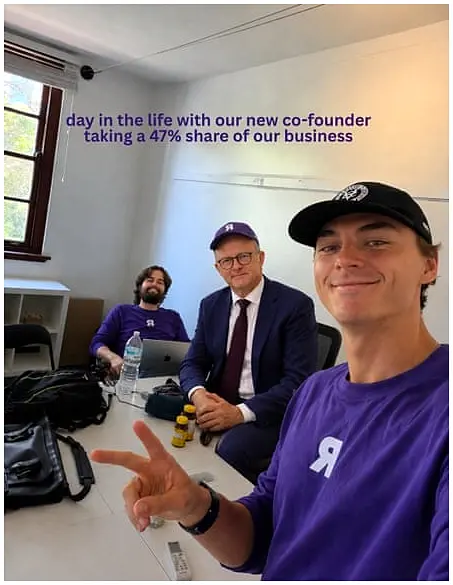
The sentiment is clear: founders feel overlooked, or worse, actively disincentivized. Alfie Robertson, creator of the video editing app Roll, shared his own AI-generated images of Albanese, depicting him in a gym, recording a podcast, or poring over strategy. Robertson’s concern isn’t just about the tax itself. It’s about the underlying incentives. “Policies like this shape where founders choose to build, invest and stay,” he observed, adding that Australia, in its global pursuit of talent and innovation, should be rewarding risk-takers, not penalizing them.
Prime Minister Albanese, when pressed on the backlash, insisted his government supports the startup sector. He pointed to existing budget incentives for research and development and instant asset write-offs. Treasurer Jim Chalmers, perhaps sensing the heat, conceded that startups “may have a different kind of cost base” compared to other industries. He assured that consultations with the tech, venture capital, and startup sectors were ongoing to ensure the changes “accurately reflect the contribution” from this “really important part of the economy.”
The Tech Council of Australia, while welcoming the R&D tax incentives and venture capital reforms, remains keen to continue its dialogue on the CGT, suggesting the issue is far from resolved.
Economist Saul Eslake offers a nuanced perspective. He believes there might be a case for more generous CGT treatment specifically for new businesses built from the ground up, acknowledging they often lack a cost base to index. While backing the government’s broader CGT alterations for property and shares, Eslake questioned the extent of the disincentive. “If, instead of becoming a billionaire, you make $800m, is that less incentive?” A fair point, perhaps, but one that might miss the psychological edge that drives entrepreneurial ambition.
Conversely, economist Chris Richardson urged against any “bending” on the CGT. He argues that existing incentives like R&D tax offsets are superior to carving out future profits. Richardson champions a move towards more equitable taxation between asset income and labor income, quoting Warren Buffett: “You may run into someone with a terrific investment idea, who won’t go forward with it because of the tax he would owe when it succeeds. Send him my way. Let me unburden him.”
So, the debate rages. Will Australia’s tech ambition wither under new tax burdens? Or is this merely a necessary, albeit painful, adjustment to a more equitable financial landscape? The entrepreneurs, it seems, have already cast their votes, even if only with AI avatars.


No comments yet. Be the first to share your thoughts!