
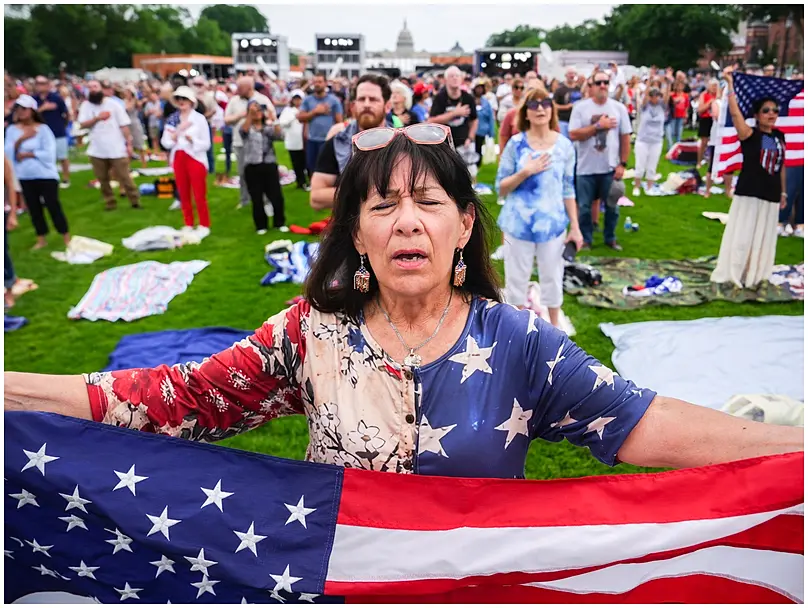
A nine-hour prayer event, staged on the National Mall, recently marked the Trump administration’s take on the country’s 250th anniversary. Dubbed “Rededicate 250: A National Jubilee of Prayer, Praise and Thanksgiving,” the Sunday gathering aimed, according to organizers, to achieve a “rededication of our country as One Nation to God.”
Performers, pastors, and civil rights leaders took the stage, alongside a contingent of Trump’s Republican allies. Senator Tim Scott of South Carolina, for instance, offered a potent soundbite to the crowd. “Our rights don’t come from the government,” Scott declared. “No, our rights come from God, the king of kings.”
Members of the Trump administration even joined via video. The President himself appeared, framed by the Resolute Desk in the White House, delivering a speech from the Book of Chronicles – a divine promise to King Solomon for protection, or destruction for those who stray. Secretary of State Marco Rubio, in his own video address, painted the U.S. as a nation singularly molded by the "Christian idea."
Rubio’s historical interpretation was pointed. “Before the Christian West, most societies – and civilisations, for that matter – thought in stagnant cycles: the flooding of the Nile, the return of the rains, the cycle of the harvest. History for them was a wheel to nowhere,” he posited. His conclusion: “But our faith calls us outwards into the limitless darkness of the unknown. It tells us to go forth and preach the gospel to the world as a witness unto all nations and to the ends of the earth.”
A Nation Divided on Faith and State
The event, predictably, wasn't without its detractors. Only one speaker, a rabbi, represented a non-Christian faith. To many, this wasn’t a sincere act of devotion at all. Just a political play.
“Rededicate 250 is a betrayal of America’s founding values guaranteed in the First Amendment – which made clear that there shall be no establishment of religion by the government and that each one of us should be free to live out our beliefs in our own way.”
That was the sharp assessment from Paul Raushenbush, a reverend and president of the Interfaith Alliance, who took to social media. His objections, he insisted, weren't about "antipathy towards religion," but a faith that compels him to honor America's diverse beliefs.
The Establishment Clause of the U.S. Constitution has, for generations, been understood to prevent the government from dictating religious beliefs. Yet, critics claim the Trump administration has consistently blurred this foundational line, citing even regular prayer services at the Department of Defense.
Trump, naturally, has countered, alleging "anti-Christian bias" within the federal government. Last year, he even launched a task force, ostensibly to root out this supposed discrimination.
Evangelical Christians remain a powerful bloc within Trump’s right-wing base. They are a force. Especially during election cycles. Trump, ever the strategist, has actively courted these voters ahead of key votes.
Their views, indeed, could reshape how the Constitution itself is read. A recent Pew Research Center survey showed a slight bump: 17 percent of U.S. adults now believe Christianity should be the nation’s official religion, up from 13 percent in 2024. But not so fast. A significant majority, around 54 percent, still back the separation of church and state. And 52 percent? They think "conservative Christians have gone too far in trying to push their religious values in the government and public schools."
The line between sacred and secular in American governance? Increasingly, it seems less a bright boundary and more a contested space.


No comments yet. Be the first to share your thoughts!