
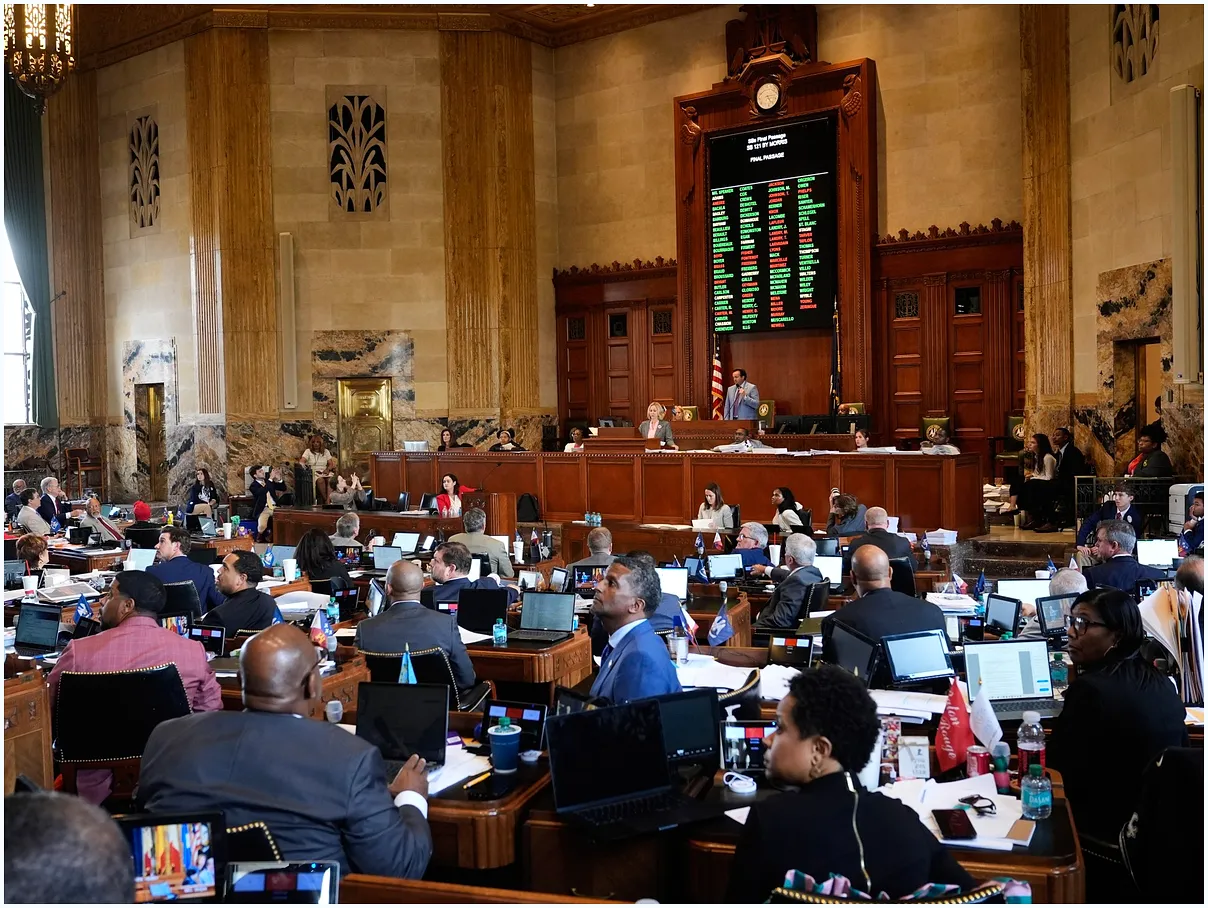
Louisiana's legislative halls just witnessed a familiar political maneuver. Lawmakers, mostly Republican, pushed through a new congressional map designed to reshuffle the state's representation in Washington. The goal? Simple: add another Republican to the U.S. House.
But this isn't merely about party numbers. The new configuration eliminates one of Louisiana's two existing majority-Black districts, both currently represented by Democrats. A contentious move. Approval came swift on Friday, just weeks after a U.S. Supreme Court ruling. That high court decision, in Louisiana v Callais, struck down the state’s previous map, ironically, as an illegal racial gerrymander because it included two majority-Black districts.
That ruling significantly weakened the 1965 federal Voting Rights Act. A landmark piece of legislation. It was meant to shield minorities from voter discrimination. Now, its teeth feel blunter.
This isn't an isolated incident. It's a flashpoint in a nationwide redistricting war. Former President Donald Trump's push to secure a slim House majority for Republicans has fueled this frenzy, particularly across the South. Louisiana, it seems, is merely one battlefield.
Republicans in the state had considered a bolder play: aiming for all six House seats. But that would mean diluting Republican-held districts with more registered Democrats, a gamble that could backfire. So, a more measured approach. Currently, Republicans hold four of six seats. This new map projects a fifth.
The state Senate's vote was a clear 28-to-10. Republican Governor Jeff Landry is expected to ink it into law, despite immediate threats of further litigation.
The Senate floor debate, though brief, laid bare the raw partisan divisions. Democrats argued vociferously: this map, they contended, is a racial gerrymander. It's designed to cram more Black voters, who predominantly lean Democratic, into a single district. A blatant manipulation.
State Senator Royce Duplessis, a Democrat, pointedly noted other Southern states, like South Carolina, chose not to redraw maps mid-election cycle. Louisiana, he warned, is joining a "vicious, vicious race to the bottom." Harsh words. And perhaps, accurate.
"I purposely put more Democrats into District 2 to make the remaining districts better performing for Republicans."
Jay Morris, the Republican state Senator sponsoring the bill, countered. He insisted party affiliation, not race, was the sole driver behind the new boundaries. His candid admission, however, raised eyebrows: "I purposely put more Democrats into District 2 to make the remaining districts better performing for Republicans." He even claimed instructing demographers to ignore racial data. Hard to believe for many observers.
Democratic Senator Sam Jenkins was unconvinced. "I think it’s a racially gerrymandered district that’s going to get us into a lot of trouble here." Morris's curt reply: "Agree to disagree."
The legal merry-go-round continues. Louisiana had been using a court-ordered map from 2024, one that did comply with the Voting Rights Act by creating a second majority-Black district. But then the Supreme Court intervened, striking it down on April 30. Governor Landry, anticipating the new map, had already postponed the state’s primary. A scramble.
The redrawn district currently represented by Democratic Representative Cleo Fields now clusters around predominantly white communities near Baton Rouge. Meanwhile, a chunk of Baton Rouge gets added to the heavily Democratic, majority-Black district of Representative Troy Carter, based in New Orleans. Surgical, some might say.
More lawsuits? Count on it. The American Civil Liberties Union (ACLU) of Louisiana minced no words. They threatened legal action, labeling the map a "racial gerrymander hiding behind the thin veneer of partisanship." A pointed accusation. "This fight is just beginning," the ACLU added. It always is.
Curiously, even the victorious plaintiffs from the Supreme Court's decision found fault with the legislature's map. They criticized it for leaving even one majority-Black district in place. The political calculus, it seems, satisfies very few.
Across the South, emboldened by the weakened Voting Rights Act, other Republican-controlled states are following suit, redrawing their own lines. Republicans, for now, appear to be winning the national redistricting contest, passing more partisan maps to bolster their House numbers. A potential gain of up to 15 seats, they project. Democrats eye perhaps six from California and Utah. Small consolation.
A recent Wisconsin court decision, however, offered a glimmer of hope for Democrats, perhaps for 2028. The liberal-leaning Wisconsin Supreme Court agreed to hear an appeal challenging their state’s Republican-friendly districts. Republicans hold six of eight House seats there. Only two are truly competitive. It's a long shot for 2026, but the political tectonic plates are always shifting. Always.



No comments yet. Be the first to share your thoughts!