
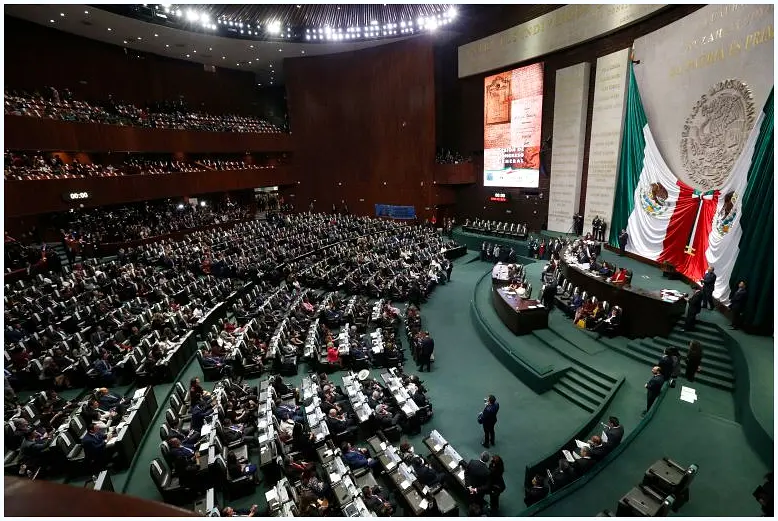
MEXICO CITY – Mexico’s political establishment just got a jolt. The lower house of Congress has signed off on a constitutional amendment that would empower authorities to nullify elections, citing foreign interference as grounds. The move, proponents say, fortifies national sovereignty. Critics? They call it a recipe for chaos, an open invitation to challenge legitimate democratic outcomes.
On Thursday, the Chamber of Deputies gave its nod to the measure, a decisive 307 votes for, 128 against, and a single abstention. The proposal aims to append “foreign interference” to the existing list of reasons an election might be declared invalid. But the path ahead is far from clear. Senate approval is still required. And even if it passes, its immediate impact is questionable; the 2027 federal elections are likely beyond its reach due to timing constraints.
What exactly constitutes this “foreign interference”? The reform attempts to spell it out: “illicit financing, propaganda, the systematic dissemination of disinformation, digital manipulation, and the intervention of foreign governments or agencies.” It doesn't stop there. Any acts of political, economic, diplomatic, or media pressure designed to sway public opinion fall under its expansive umbrella.
A Shield or a Sledgehammer?
Ricardo Monreal, who leads the ruling Morena party in the lower house, champions the amendment. He frames it as a vital shield for Mexico's democracy. Stronger constitutional barriers, he insists, are essential to prevent external players from dictating electoral results. “After more than 30 straight hours of work, we in Mexico’s lower house approved reforms to strengthen our electoral system, judicial elections and Mexico’s democratic sovereignty,” Monreal stated, celebrating the legislative marathon.
But the opposition isn’t buying it. Lawmakers from rival parties accuse Morena of inflating the threat, cynically crafting a justification for a reform that could prove deeply problematic. Curiously, Monreal also moved to withdraw accompanying secondary legislation that would have detailed the precise mechanisms for identifying foreign interference and applying the new nullification rules. The party’s reasoning: not enough time to implement before crucial legal deadlines for the 2027 election cycle. Electoral reforms, after all, must be enacted at least 90 days prior to the commencement of the election process to be applicable.
“We reject any foreign intervention. The problem is that we are in a debate that confuses intervention with meddling, which are different things.”
This legislative push comes amidst a palpable unease within Morena regarding what they perceive as increasing foreign entanglement in Mexican affairs. Party figures have recently pointed to criticisms from overseas politicians and comments from former U.S. President Donald Trump as prime examples of external pressure that could, they believe, sway domestic politics. President Claudia Sheinbaum echoed these sentiments. “There could be a risk of foreign interference in Mexico’s elections,” she commented during a news conference, acknowledging past instances of foreign funding directed at local candidates and organizations.
A Slippery Slope?
For the opposition, the reform raises more questions than it answers. Jose Elias Lixa, coordinator for the National Action Party (PAN), flatly rejected the insinuation that opposing the amendment translates to an endorsement of foreign interference. “We do not accept that kind of argument,” Lixa told his fellow lawmakers. “It would be like saying that those who opposed annulling elections because of organised crime interference are against fighting organised crime.”
Ruben Moreira Valdez of the Institutional Revolutionary Party (PRI) voiced similar concerns. His party, he affirmed, stands against foreign intervention, full stop. The real issue, he argued, lies in the practical application of these nebulous new rules. Valdez fears the amendment’s sweeping language could unleash a torrent of uncertainty as lawmakers eventually attempt to draft the necessary implementing legislation. What happens, he mused, “if someone buys advertising abroad, if an international news story is disseminated in Mexico, or if the argument of meddling is used to restrict content and opinions?” A potent question. The future of Mexican electoral integrity hangs in the balance, now perhaps more than ever.



No comments yet. Be the first to share your thoughts!