
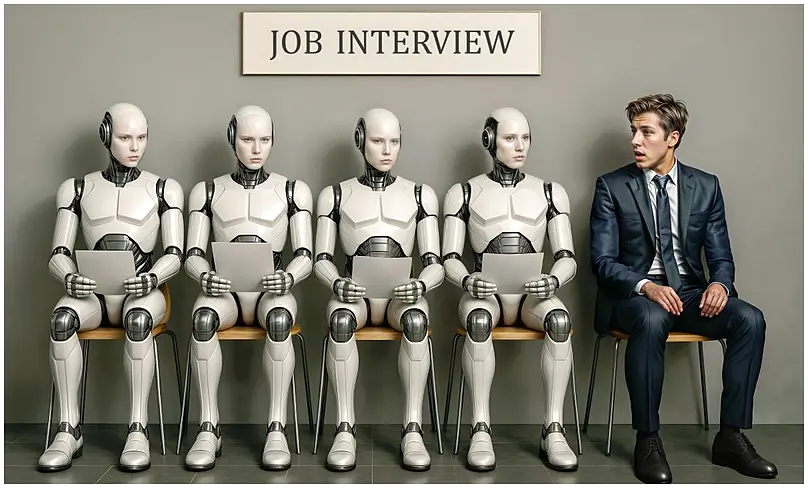
The AI revolution promised widespread disruption. Many predicted a bloodbath for entry-level positions. But new data suggests a twist: the job market might just be tipping in favor of the seasoned professional. Call it the great reversal.
A recent Oliver Wyman survey reveals a jarring shift. Nearly 40% of chief executives are eyeing cuts to junior roles over the next year or two. Their goal? Reshaping staff towards mid-level and senior talent. Last year, the script was flipped, with companies favoring junior hires. Now? Just 17% of CEOs plan to expand their entry-level ranks. The shift is stark.
John Romeo, who spearheads Oliver Wyman's research, put it bluntly to Bloomberg: “The junior level is definitely finding it harder now to enter the workforce.” It's experience they want. Companies, he says, are now leaning on “mid- and senior-level employees... to drive productivity.”
The reason is simple, yet profound. AI agents excel at tasks once handled by new recruits. Coding at a junior developer's level? AI handles it. What AI can't replicate, however, are the nuanced judgment calls. The insights forged over years. The kind only a human, with accumulated wisdom, can deliver.
But AI adoption isn't some smooth, uniform march. The Oliver Wyman report also flags a “deepening” chasm. Many companies remain stuck in neutral, bogged down in planning. A full two-thirds of businesses surveyed are still in the pilot or planning stages for AI integration. Over half, 53%, admit it's too soon to gauge any real return on investment—a significant jump from 41% last year.
"Yet those scaling AI across two or more use cases report roughly twice the ROI, measured in both cost savings and revenue gains."
The message is clear: hesitate, and you lose. Scale, and you win big. Size matters, too. Mega-corporations are nearly five times more likely than their mid-sized counterparts to report AI-driven cost savings exceeding 10%.
This mirrors findings from PYMNTS Intelligence. Their report, “No Roadmap, No Problem: How Enterprises Are Reinventing the AI Workforce,” noted that major U.S. companies have largely moved past mere experimentation. AI is now embedded in daily operations.
Still, the path forward is anything but standardized. PYMNTS highlighted last week that while most executives see AI as essential, their specific strategies diverge wildly by industry. And confidence in execution? Mixed, at best. Half of surveyed CFOs anticipate AI will create entirely new roles, demanding fresh skills. Yet, almost as many, 47%, foresee job cuts. A paradox.
So, as the algorithms churn, the corporate world grapples with a future few truly predicted. Experience, it seems, might just be AI's most unexpected ally. Or perhaps, its last stand.



No comments yet. Be the first to share your thoughts!