
Every year, like an unwelcome houseguest, the same tired financial advice creaks open the door: "Sell in May and go away." It's a cliché. And this year? Following it could prove wildly expensive.
For decades, this maxim has dictated investment strategies, urging investors to retreat from the market until autumn. I've never been a true believer. But in today's shifting financial currents, I'm convinced that succumbing to this age-old wisdom means missing out on one of the most compelling opportunities in years: "the Summer of Small Caps."
Before we dissect why this summer is different, let's briefly acknowledge the origins of this peculiar market lore. It didn't even start on Wall Street. Its roots lie in 19th-century London, where wealthy financiers, desperate to escape the city's sweltering streets, decamped to their country estates for extended vacations. Trading volumes plummeted. Markets went quiet. Stocks often drifted sideways or even lower until the money men returned, refreshed, in the fall.
The full saying was quite poetic, if a little elitist: "Sell in May and go away, come back on St. Leger's Day." That's a famous British horse race, dating back to 1776, marking the end of the social season in September. So, essentially, the elite were telling each other to check out of the market until the horse races. When this phenomenon made its way across the Atlantic, it stuck. And for a while, it actually worked. From 1950 to around 2003, the data seemed to back it up.
Frankly, if I were in charge, I’d close the market for the entire month of August every year. That’s when the ‘A-team’ heads to the Hamptons or jets off to Europe for vacation.
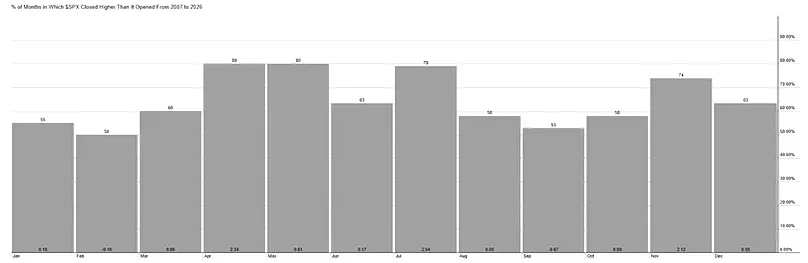
But here's the kicker: once everyone knows a 'secret,' it stops being one. That’s true for trading strategies, market adages, and everything in between. Sure, summer months aren't uniformly strong. August and September, for instance, remain two of the weakest on record. The S&P 500 has averaged a paltry 0.05% in August over the past two decades, and a negative 0.67% in September.
Yet, the conventional wisdom breaks down decisively when you examine the entire May-through-October window. Focus on just the last 20 years, and July emerges as the market's single best month overall – rising an average of 2.54%. Not November. Not April. July. So, clinging to "sell in May and go away" doesn't just put you on the sidelines during weak periods. It forces you to sit out some of the most profitable trading days of the year.
Now, here's where following the old guard could genuinely cost you this year. The S&P 500, everyone's favorite benchmark, tracks only large-cap companies. But right now, the small-cap Russell 2000 index? It's on fire. This summer is shaping up to be one of the best periods for smaller stocks in years.
While everyone fixated on the Magnificent Seven and the AI mega-cap frenzy, a quiet rotation has been unfolding in smaller companies. Over the past year, the Russell 2000 has surged 31%, eclipsing the S&P 500's 23%. Year to date, small caps continue to lead, climbing 11% compared to the S&P 500's 7.7%.
What makes these smaller firms so compelling right now? Their predominantly domestic focus. They largely bypass the global exposure that makes large caps vulnerable to currency swings, geopolitical shocks, and international economic slowdowns. When the U.S. economy grows – and it is – small caps typically feel that benefit most directly.
Even more exciting, small caps remain undervalued relative to historical norms. They currently represent just 4.6% of the total Russell 3000 market cap, significantly below the historical average of 7.6%. This valuation gap persists even after their recent rally. In short, the ascent has begun. But it’s far from over.
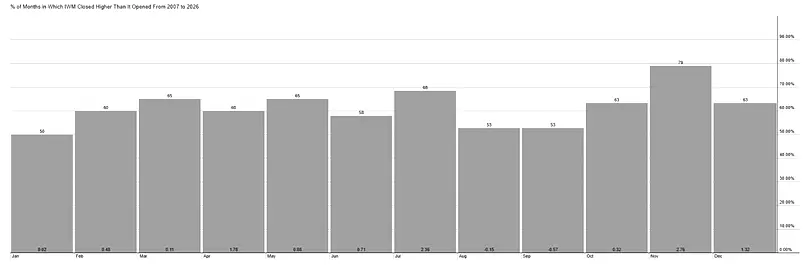
After years of playing second fiddle to mega-cap tech, capital is now shifting toward smaller, domestically focused enterprises exhibiting genuine earnings growth and direct exposure to the American economy. And if you're keen on seasonality, consider this: July has been the second-strongest month for small caps over the past two decades, delivering an average 2.36% return.
That's right around the corner, folks.
The bottom line: this is emphatically not the summer to be sitting on the sidelines. The small-cap opportunity is tangible. But you can’t just blindly buy the iShares Russell 2000 ETF (IWM) and expect magic. You need to find the right ones.
My proprietary Stock Grader system was designed for precisely this challenge. Every week, it meticulously evaluates roughly 6,000 stocks based on two critical signals: the underlying health of the business and whether institutional money is quietly accumulating shares ahead of the headlines. When both signals fire in unison, month after month, I pay very close attention. The gains usually follow.
Through incorporating Stock Grader into my Breakthrough Stocks service, where I focus on small- and mid-cap companies, my subscribers are currently enjoying 11 triple-digit gains across 29 holdings. Every single one of these was a smaller, under-the-radar company when my system flagged it. Every one was too small for the biggest Wall Street funds to bother with. And every one displayed that early, powerful combination of strong fundamentals and buying pressure before the masses caught on.
The next group of winners is already out there. My system has, in fact, flagged 53 stocks showing those same early signals. Last week, I hosted my 10X Fed Shock event, where I meticulously laid out the full case for why I believe this represents the most significant small-cap opportunity I’ve witnessed in decades. I shared my highest-conviction picks from those 53 stocks. And I even gave away one name for free, just for attending.
Your chance to watch a replay, however, is closing. Midnight isn't far off. Will you seize the summer, or watch it slip away?



No comments yet. Be the first to share your thoughts!