
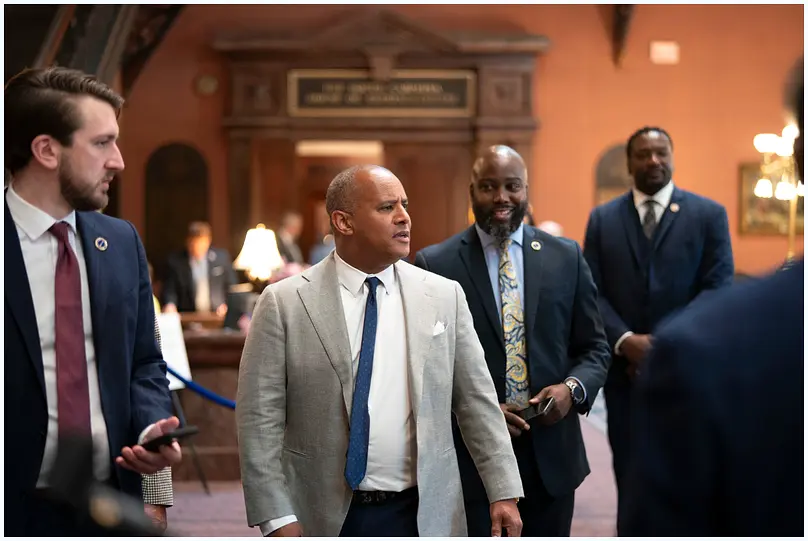
President Donald Trump’s aggressive campaign to redraw congressional districts before the November elections just ran into a brick wall. Twice. On Tuesday, South Carolina senators refused to play ball, and a federal court in Alabama blocked a Republican-backed map outright.
In-person voting for South Carolina’s primaries had already begun. Yet, the state Senate considered a Republican scheme to halt those ongoing congressional votes. The idea? Schedule a brand-new primary under redrawn districts. A cynical move, some called it, explicitly designed to unseat a long-serving Democrat.
Too late, many senators declared. Much too late.
Republican state Sen. Richard Cash didn't mince words. He said, "South Carolina citizens are going to the polls today. And neither my conscience or common sense is going to let me stop an election that is already underway."
This political maneuvering in South Carolina isn't an isolated incident. It's part of a wider Republican strategy, fueled by Trump himself, to gerrymander voting districts. The goal? To bolster the GOP's position and, hopefully, retain a wafer-thin House majority in the midterms. Republicans have been quick to exploit a recent U.S. Supreme Court ruling that chipped away at minority protections under the federal Voting Rights Act. A clear opportunity, they thought.
But Tuesday brought another significant blow. This time, in Alabama. A three-judge federal panel issued a preliminary injunction. It blocked the state from using a Republican-drawn congressional map that could have handed the GOP an extra seat. The court's reasoning was stark: the Republican plan “intentionally discriminated based on race” by limiting districts with a Black majority to just one. The ruling mandated the continued use of a court-imposed map, one that includes two districts boasting a substantial proportion of Black residents.
Alabama Attorney General Steve Marshall, a Republican, immediately vowed an appeal to the U.S. Supreme Court. He predicted victory. A bold claim.
Among the first to cast an early ballot in Orangeburg was U.S. Rep. Jim Clyburn. The very Democrat whose district Republicans were so keen on reshaping. He remained defiant, insisting he would run for reelection, regardless of how the lines were drawn.
"I’m OK if it’s Trump plus 20," Clyburn quipped, referencing the potential Republican advantage in a redrawn district. "I would be running where I live."
Democrats, despite their own struggles in the national redistricting wars, found reason to cheer Alabama's turn of events. Marina Jenkins, executive director of the National Redistricting Foundation, a Democratic affiliate, put it bluntly:
The fight for justice is far from over in states across the country where politicians are enacting gerrymanders on top of gerrymanders to erase equal representation for communities of color.
Typically, voting districts are redrawn only after a census, at the decade's start. But Trump, pushing against historical headwinds that often see the president’s party lose congressional seats in midterms, urged Republican-led states to move faster. To redraw before November.
Since Trump first lobbied Texas last summer, Republicans have indeed enacted new House districts in Missouri, North Carolina, Ohio, Florida, and Tennessee. Elsewhere, California adopted new Democratic-drawn districts, and a court imposed a favorable map for Democrats in Utah. Virginia, however, delivered a setback for Democrats, with the state Supreme Court invalidating a voter-approved redistricting plan.
Discussions continue in Louisiana, following an April high court ruling that struck down a majority-Black congressional district. The Louisiana House might vote this week on a new map. It could potentially eliminate a seat held by Democratic U.S. Rep. Cleo Fields, boosting Republican chances to capture six of the state’s seven seats. The stakes are high.
The Congressional Black Caucus didn't stay silent. On Tuesday, it called on major U.S. corporations—including those that previously championed voting rights and racial justice—to oppose Republican-led redistricting efforts targeting Black-majority House districts. This follows a controversial call last week for Black athletes to boycott public universities in states engaged in such gerrymandering.
Over 26,000 votes were cast in South Carolina by noon Tuesday on the first day of early voting for the June 9 primary. Democrats had urged turnout against the proposed new map. For context, the entire two weeks of early voting in 2022 saw only about 125,000 votes.
The Republican-led House already passed a plan. It would reconfigure Clyburn's district. It would void the current congressional primary results. It would instead hold new U.S. House primaries in August.
Trump has personally lobbied for this. He made at least two calls to Republican state Senate Majority Leader Shane Massey. He even phoned into a private meeting of Republican senators earlier this month. The pressure, via social media, hasn't let up.
Debate has stalled in the Senate. Democrats are vehemently opposed. Even some GOP lawmakers harbor concerns. They worry an aggressive redistricting push could backfire, making some Republican-held seats vulnerable to losses by injecting too many Democratic voters. A risky game.
Clyburn recalled the last redistricting after the 2020 census. Lawmakers spent months. Public meetings, suggestions from across the state. An orderly, fair process, he claimed, even if it resulted in a 6-1 Republican advantage.
"When the map was challenged, the U.S. Supreme Court said, yes, this is constitutional," Clyburn asserted. But now, "this White House says, to hell with the process, to hell with the Constitution, just do what we want done." A chilling thought for anyone who believes in established norms.



No comments yet. Be the first to share your thoughts!