
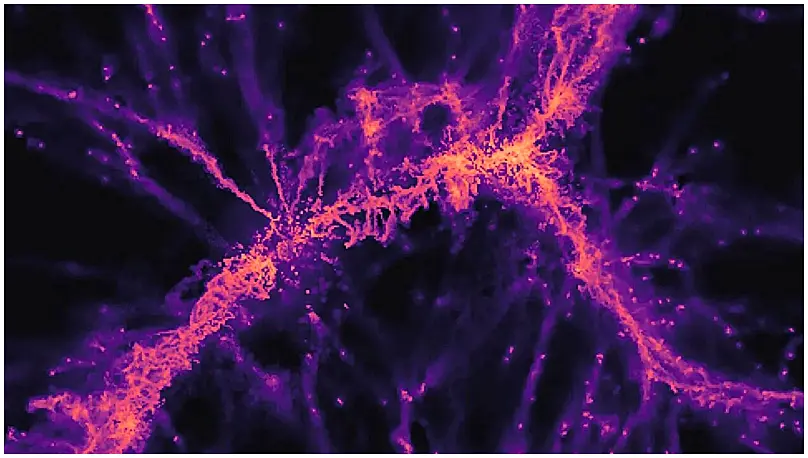
For eons, astronomers have grappled with the universe's grandest, yet most elusive, structure: the cosmic web. This gargantuan, hidden network of matter threads across the cosmos, linking galaxies like beads on an invisible string. Now, an international team, after hundreds of painstaking hours, claims a triumph. They've captured the clearest-ever glimpse of one such filament, a crucial link connecting two actively forming galaxies from a time when the universe was just a toddler, a mere two billion years old.
This isn't just another pretty picture. It's a rare, direct look at one of existence's largest structures. A game-changer, perhaps. It could fundamentally alter how researchers understand galactic growth, how these island universes evolve across the vast sweep of cosmic time.
Dark Matter's Blueprint
Modern cosmology paints a stark picture: 85% of all matter in the universe is dark. Invisible. We can't see it, can't touch it. Yet, this unseen material is believed to dictate the universe's architecture, weaving a gigantic, web-like framework of long filaments. Galaxies, those brilliant cosmic cities, coalesce and shine brightest at the intersections of these dark threads.
These filaments aren't just cosmic scaffolding; they're believed to be superhighways. Intergalactic arteries, funneling gas into galaxies, igniting the birth of new stars. Understanding how this gas moves, how it's transported along this cosmic web, is essential. A foundational question for galaxy development.
But detecting that gas? It's been an uphill battle. Most intergalactic gas has remained a ghost, observed only indirectly by its tell-tale absorption of light from distant, bright objects. Hydrogen, the universe's most abundant element, emits a glow so faint, so whisper-thin, that direct observation has been nearly impossible for past generations of instruments.
Hundreds of Hours, One Clear View
The breakthrough arrives courtesy of researchers from the University of Milano-Bicocca, alongside scientists from the Max Planck Institute for Astrophysics (MPA). Their tool? MUSE, the Multi-Unit Spectroscopic Explorer, a powerful eye mounted on the European Southern Observatory's Very Large Telescope in Chile.
Even with such cutting-edge tech, this was no casual evening at the observatory. It required one of the most ambitious MUSE campaigns ever attempted in a single sky region. Researchers spent hundreds of hours, collecting data relentlessly. All to tease out the faint filament's signal, clear enough for detailed analysis.
Davide Tornotti, a PhD student at the University of Milano-Bicocca, spearheaded the study. The result: the sharpest image yet of a cosmic filament, a structure stretching roughly three million light-years. It connects two galaxies, each harboring an active supermassive black hole. Unsettling, isn't it?
The findings, published in Nature Astronomy, offer a fresh path. A new way to scrutinize the physical properties of gas residing within these intergalactic filaments. A door has opened.
"By capturing the faint light emitted by this filament, which traveled for just under 12 billion years to reach Earth, we were able to precisely characterize its shape. For the first time, we could trace the boundary between the gas residing in galaxies and the material contained within the cosmic web through direct measurements."
To give context to these raw observations, the team turned to supercomputer simulations of the universe, crafted at MPA. These digital models predict what such filamentary structures *should* look like, based on current cosmological understanding. The verdict? A substantial agreement. Reality, it seems, aligns with theory.
New Clues, Lingering Questions
This successful match isn't just satisfying; it bolsters confidence. Confidence in our understanding of how gas is distributed around galaxies. Confidence in how galaxies receive the raw material they need to churn out new stars.
Scientists aren't stopping here. They now aim to identify more of these ethereal structures, building a broader, more comprehensive picture of how matter flows through the universe's grand, unseen web.
Fabrizio Arrigoni Battaia, an MPA staff scientist involved in the study, puts it plainly: "We are thrilled by this direct, high-definition observation of a cosmic filament. But as people say in Bavaria: 'Eine ist keine' -- one doesn't count. So we are gathering further data to uncover more such structures, with the ultimate goal to have a comprehensive vision of how gas is distributed and flows in the cosmic web." One down, an entire universe to map. The work, it seems, has just begun.


No comments yet. Be the first to share your thoughts!