
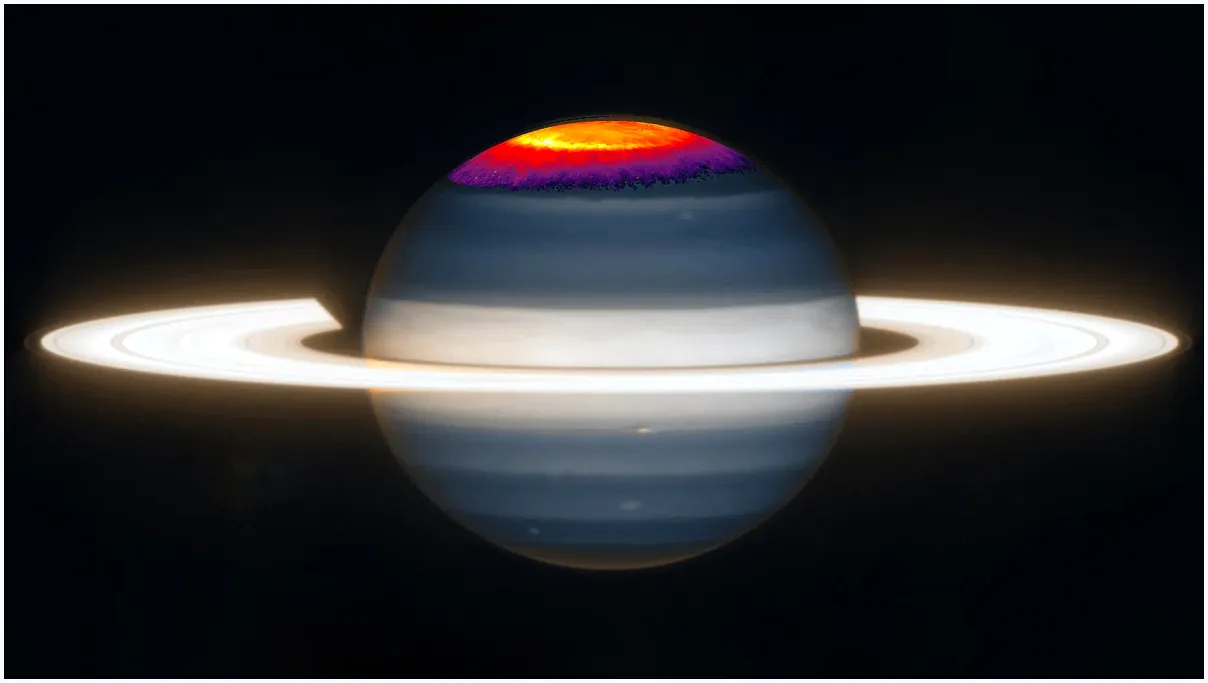
For decades, a baffling astronomical puzzle perplexed scientists: Saturn, the ringed jewel of our solar system, seemed to be breaking the rules of physics. Its rotation rate, by all accounts, appeared to fluctuate. Was the gas giant really speeding up, then slowing down? Such a notion simply defied planetary mechanics. No explanation made sense. Now, courtesy of the formidable James Webb Space Telescope (JWST), that perplexing mystery has finally dissipated.
New research, hot off the presses in the Journal of Geophysical Research: Space Physics, pins the blame on Saturn's iconic northern lights. These aren't just a pretty spectacle. The planet's aurora, it turns out, drives a powerful, self-sustaining loop involving heat, atmospheric winds, and electrical currents. This intricate dance creates the illusion of a shifting spin rate, entirely dependent on how the measurements are taken.
The Longstanding Riddle of Saturn's 'Changing' Spin
The anomaly isn't new; it dates back ages. However, it gained fresh urgency in 2004, when NASA's Cassini spacecraft provided data suggesting a gradual change in Saturn's spin. This was a head-scratcher. Planets don't just whimsically alter their rotational velocity over short timescales.
A critical turning point came in 2021. A team led by Professor Tom Stallard of Northumbria University offered a compelling alternative: Saturn's rotation wasn't changing at all. Instead, electrical signals tied to the aurora were being distorted by fierce winds in the upper atmosphere. These winds, in turn, generated electrical currents, skewing the very auroral signal scientists relied upon to estimate the planet's rotation.
That theory explained the misleading measurements. But a bigger question loomed: What, precisely, was powering those atmospheric winds?
JWST Illuminates Saturn's Hidden Engine
To unravel that remaining thread, Stallard and his international collaborators set their sights on the James Webb Space Telescope. They observed Saturn's northern auroral region continuously, for a full Saturnian day. The level of detail captured was simply unprecedented.
Researchers honed in on infrared light from a molecule called trihydrogen cation, a natural temperature gauge in Saturn's upper atmosphere. Analyzing its faint glow, the team constructed the most intricate maps yet of temperatures and charged particle densities within the auroral region. The leap in accuracy was stark. Previous measurements carried a hefty 50-degree Celsius uncertainty. JWST's data? Ten times more precise. This allowed for the first-ever detection of localized heating and cooling patterns.
What we are seeing is essentially a planetary heat pump. Saturn's aurora heats its atmosphere, the atmosphere drives winds, the winds produce currents that power the aurora, and so it goes on. The system feeds itself.
The new observations perfectly aligned with computer models developed over a decade ago. But there was a catch: those models only worked if the atmospheric heating originated precisely where the strongest auroral particles slammed into Saturn's atmosphere.
These findings indicate the aurora is far more than a dazzling light show. It's a central player in a planetary engine. Energy from the aurora superheats specific atmospheric zones. That heat generates winds. Those winds, in turn, create electrical currents. These currents then feed energy back into the aurora itself, which continues heating the atmosphere, perpetuating the entire cycle. It's a self-sustaining system, a planetary heat pump in constant operation.
Professor Stallard put it plainly:


No comments yet. Be the first to share your thoughts!