
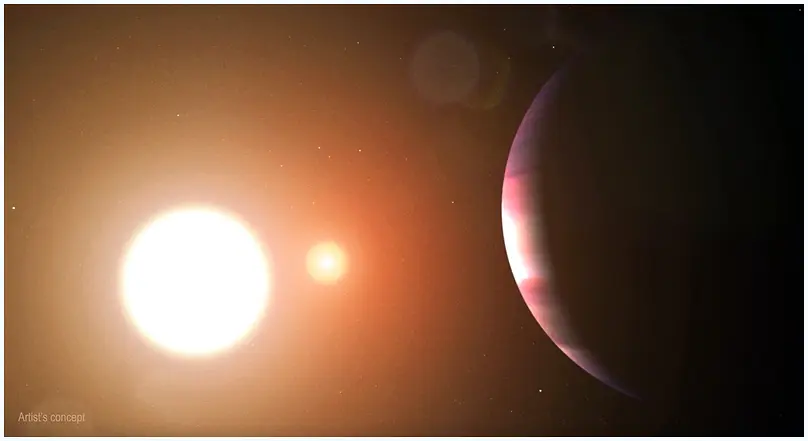
Our Sun, it turns out, is something of a recluse. It drifts through the vastness of space without a celestial partner, a singular star in a largely crowded cosmos. This solitary existence, however, is hardly the norm. Most stars, we've long suspected, prefer company; they're gravitationally bound to at least one other star.
Understanding these stellar relationships isn't just an academic curiosity. It's absolutely vital for the next frontier of astronomy: hunting for exoplanets. Especially those that might harbor life. Imagine the implications if a significant portion of our nearest stellar neighbors are actually elaborate dance partners.
The Neighbors Next Door: A Definitive Census
Enter a groundbreaking new paper. Researchers from the University of Madrid, publishing their work on the arXiv preprint server, have meticulously categorized nearly every star within a 10-light-year radius. This isn't just adding to the literature; it's practically a new star chart for the coming generation of planet-hunting satellites.
The study cast its net wide, yet deliberately. It examined stars out to 10 parsecs—a distance equivalent to 32.6 light-years from our own solar system. Why that specific boundary? Simple: the farther you look, the harder it becomes to definitively spot every companion star. Limiting the distance ensures a 'complete' picture, minimizing the chance of missing a hidden stellar friend.
Crafting this cosmic census was no small feat. It involved a colossal dataset, marrying the meticulous DR3 data release from the European Space Agency's Gaia telescope with the decades-spanning records of the Washington Double Star Catalog. The final tally? A staggering 424 known stellar and sub-stellar objects packed into that 10-parsec bubble. And of those, 215 were found to be entangled in 92 distinct multiple star systems.
Cosmic Social Dynamics: Size Matters
Among those 92 systems, the breakdown is fascinating. Sixty-eight were classic binary pairs. Nineteen were triples, featuring three stars. Three systems boasted quadruplets. And, incredibly, two were extremely rare and complex quintuple star systems. Five stars, orbiting each other in an intricate celestial ballet.
But perhaps the most striking revelation was the direct link between a star's mass and its 'relationship status.'
If a star tips the scales at more than half the mass of our Sun, it faces a remarkable 41% chance of being paired up. They like to travel in twos, or more. Smaller stars? They're a different breed. For the cosmic featherweights—think red and brown dwarfs, those dim objects under 0.1 solar masses—the likelihood of finding a partner plummets to a mere 9%. It seems the universe has its own social hierarchy: the heavyweights often form packs, while the lighter individuals tend to be cosmic introverts.
Orbital dynamics also proved wildly diverse. Some tightly bound pairs whip around each other in a matter of days. Others, far more distantly separated, take tens of millions of years for a single orbit. At first glance, some of these distant pairs might not even appear gravitationally connected. Yet, the researchers meticulously calculated their binding energies, confirming their enduring cosmic embrace.
A Vetted Roadmap for Future Exploration
So, why does this all matter, beyond satisfying our inherent curiosity about the heavens? The immediate answer is it deepens our understanding of how stars are born and evolve. But the long-term, perhaps more dramatic, implication centers squarely on the search for potentially habitable exoplanets.
Companion stars are, frankly, a massive headache for planet hunters. Their gravitational influence on a primary star can warp the very radial velocity readings we use to detect orbiting exoplanets. It’s like trying to hear a whisper during a rock concert.
The problem only escalates with the next generation of space telescopes. Missions like NASA's Habitable Worlds Observatory (HWO) and ESA's Larger Interferometer For Exoplanets (LIFE) are designed to directly image Earth-like planets. Imagine spending weeks, perhaps months, staring intently at a promising exoplanet candidate, only for the data to be utterly ruined by light contamination or unexpected gravitational perturbations from a previously unknown companion star. Precious, invaluable scientific time, utterly wasted.
This new paper, then, offers a critical solution: a meticulously vetted target list for these future observatories. It's the culmination of extensive research, providing a definitive map of our stellar neighborhood. As humanity pushes further into the cosmos, seeking another Earth, such detailed groundwork isn't just helpful. It's essential. Suddenly, our lonely Sun doesn't feel quite so isolated when we know where to look for others.


No comments yet. Be the first to share your thoughts!