
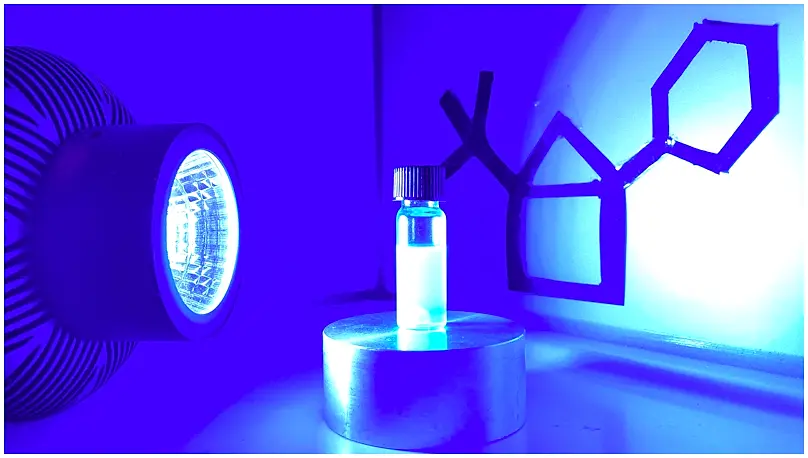
Developing new medicines often hinges on finding the perfect molecular building blocks. Consider penicillin: its potency relies on small, intricate ring-shaped molecules that store a surprising amount of internal tension. These strained structures aren't just pretty; they're powerhouses, driving crucial chemical reactions, making the creation of complex compounds far more efficient.
Now, a research team from the University of Münster's Institute of Organic Chemistry in Germany, led by Professor Frank Glorius, has unveiled a new method for crafting one of these notoriously difficult molecular structures. They've found a way to transform common starting materials into compact, highly strained molecules dubbed "housanes." The name? Obvious, really. They look like a child's drawing of a house.
Why These Tiny Houses Matter
Think of high-strain molecules like a bent tree branch, held under intense pressure. That stored energy is their secret weapon. It can be unleashed during subsequent reactions, making them incredibly valuable tools for synthesizing everything from industrial chemicals to life-saving pharmaceuticals. A chemist's dream, really.
Yet, their importance doesn't make them easy to work with. Far from it. Manufacturing these molecules has always been a significant hurdle. Earlier approaches for housanes demanded extreme temperatures and harsh conditions. Even worse, those methods balked at additional atoms or molecular side groups – the "functional groups" – attached to the starting materials. These aren't just decorative; functional groups dictate a molecule's behavior and properties. A major limitation, indeed.
Lighting the Way Forward
The Münster team started with hydrocarbons called 1,4-dienes. Normally, these compounds are a nightmare under light exposure; they typically undergo unwanted side reactions, mucking up the whole process. So, the researchers got clever. They tweaked the molecular side chains of the starting materials. A small change, with huge implications.
This adjustment successfully suppressed those competing reactions. Suddenly, the chemistry became controlled. Predictable. With the unwanted pathways blocked, the molecules were free to fold into the precise, strained ring structure needed for housanes.
Forging these molecular rings is an "energetically uphill" battle, requiring a surge of momentum. Light, it turns out, delivers just that.
According to Frank Glorius, "This process is normally difficult to achieve because it is energetically 'uphill' and requires additional momentum. Photocatalysis provides the necessary energy." It's an elegant solution: using light as a precise energy transfer agent, kickstarting a transformation that would otherwise be impossible or impractical.
To ensure they weren't just stumbling in the dark, the team also employed computer-based analyses. Understanding the reaction mechanism, how the transformation actually unfolds, is just as critical as performing it.
The potential implications are considerable. This new technique isn't just a lab curiosity; it offers a more efficient, more accessible route to housanes. Crucially, it expands the types of molecules that can be built from these high-tension structures. For fundamental chemistry research, it's a new playground. For pharmaceutical manufacturing and the development of advanced materials, it could mean faster pipelines, more diverse compounds. The era of precision molecular engineering might just be getting a lot brighter.



No comments yet. Be the first to share your thoughts!