
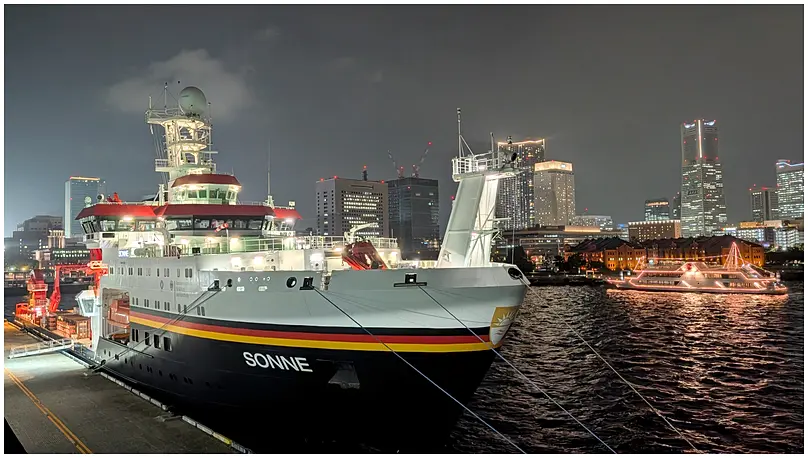
Lost for decades beneath the vast expanse of the North Pacific, a colossal, T-shaped underwater plateau known as Hess Rise is finally giving up its secrets. Nestled between the distant shores of Japan and Canada, this immense structure, roughly 1,000 kilometers long, has remained an enigma. Remote. Practically untouched. Its last serious scientific visit? 1980. Until now.
German and Japanese researchers, spearheading the SO320/1 expedition from GEOMAR Helmholtz Centre for Ocean Research Kiel, are currently subjecting the plateau's western and northern flanks to intense scrutiny. Their mission: to crack the code of its genesis. How did such a titanic landform emerge from the deep?
The journey itself speaks to the remoteness. "The Hess Rise is so far from the mainland that we have scheduled eight days at sea just for the transit to the study area," explains expedition leader Dr. Anke Dannowski, a geophysicist at GEOMAR. Eight days. Just to get there. Another expedition, SO320/2, will follow, digging even deeper into these questions.
Oceanic plateaus are found globally, both submerged and, remarkably, sometimes uplifted onto continents. These aren't just big lumps on the seafloor. They are scars of Earth's most violent geological episodes, born from "extreme magmatic events" where lava, in unimaginable quantities, erupted repeatedly. These individual lava flows aren't small trickles. They span hundreds of kilometers, tens to hundreds of meters thick. Layer upon layer. Think truly massive.
"The investigation of Hess Rise will provide insights into the entire geotectonic evolution of the Pacific."
The Middle Cretaceous period, roughly 115 to 90 million years ago, witnessed a particularly ferocious era of volcanism. At least a dozen of Earth's largest oceanic plateaus were forged then. But the 'how' remains murky. Hess Rise, scientists hope, holds keys to that planetary puzzle.
Three primary scenarios are on the table for Hess Rise. The first posits formation along the trajectory of a migrating "Triple Junction" – a point where three tectonic plates converge. A second model suggests it materialized directly at the former Pacific-Farallon spreading center, that dynamic seam where new oceanic crust constantly forms. The third, perhaps most intriguing, paints Hess Rise as an "intraplate plateau," rising independently of plate boundaries, solely driven by a powerful mantle plume. Imagine superheated material, rising relentlessly from Earth's deep interior, punching through the crust.
Adding another layer to the mystery, researchers will also explore whether the same hotspot might have birthed the nearby Shatsky Rise some 30 million years earlier, only to reignite, in a second pulse, at Hess Rise. A geological encore? A return engagement?
The investigative arsenal is impressive. Up to 40 ocean bottom seismometers (OBS) are being deployed, sinking silently to depths of 2,000 to 5,000 meters. These autonomous sentinels will continuously log seafloor movements and pressure waves. Ship-based gravimetry, a towed magnetometer, and advanced multibeam echo sounders supplement the seismic deep dive.
This treasure trove of data promises to unveil Hess Rise's hidden composition and deep structure. The subsequent SO320/2 cruise will then collect actual rock samples from the seafloor, aiming to date these ancient relics. The geophysical insights will merge with geological hard facts, forming a comprehensive picture.
Before the research vessel SONNE even left Yokohama, a diplomatic reception onboard fostered crucial exchange between German and Japanese scientists. The German contingent also toured Japan's JAMSTEC marine research institute and its vessel KAIMEI. Even students from the German School Tokyo/Yokohama got a glimpse into life on a floating laboratory. A new chapter in Earth's story, far beneath the waves, is just beginning. What else is down there, waiting to be found?

No comments yet. Be the first to share your thoughts!