
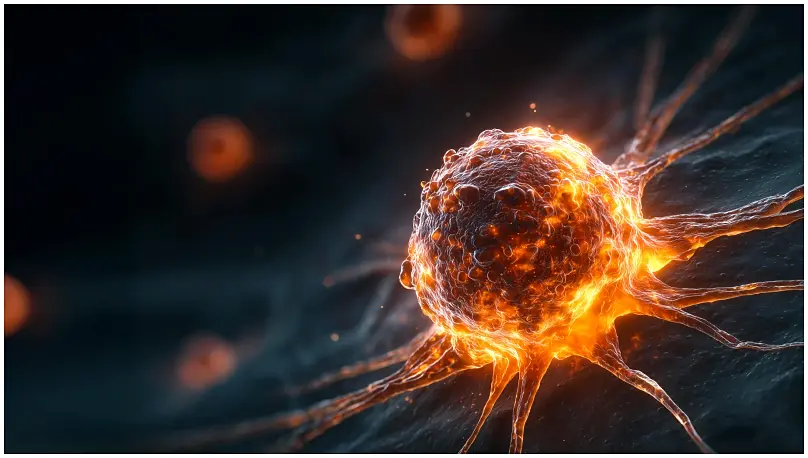
Vitamin B2. We’ve always considered it a cornerstone of good health, right? Think dairy, eggs, lean meats. Essential stuff. New research, however, paints a more unsettling picture.
This ubiquitous micronutrient, also known as riboflavin, turns out to be a double-edged sword. While our bodies can’t produce it – we must ingest it – and it does protect cells from oxidative damage, scientists have unearthed a significant, dark caveat: it might be actively helping cancer cells survive.
The Unmasking of a Shield
Researchers at the Rudolf Virchow Centre (RVZ) at Julius-Maximilians-Universität Würzburg (JMU) are behind this revelation. Their findings, published in the prestigious journal Nature Cell Biology, suggest that vitamin B2 metabolism can create a shield, making cancer cells harder to destroy. It’s a twist no one saw coming.
PhD student Vera Skafar, part of the research team led by Professor José Pedro Friedmann Angeli, didn't mince words. "Vitamin B2 plays a crucial role in protecting cancer cells from ferroptosis, a special form of programmed cell death."
Programmed cell death. It’s the body’s natural clean-up crew. Damaged, dangerous cells? They get a controlled exit, no fuss, no inflammation. Ferroptosis is one such mechanism. It’s been linked to an array of serious conditions, cancer among them. How does it work? Iron-driven damage overwhelms a cell’s antioxidant defenses.
Cancer cells are clever. They often reinforce their antioxidant defenses. Dodge the bullet. The new study pins vitamin B2 metabolism squarely in the middle of these evasive maneuvers. This means, crucially, if you could block those riboflavin-related pathways, tumors might become far more vulnerable. Easier to kill.
"Vitamin B2 plays a crucial role in protecting cancer cells from ferroptosis, a special form of programmed cell death."
A Radical New Strategy?
Central to the team's investigation was a protein known as FSP1. Healthy cells use it to sidestep unwanted death. Vitamin B2? It’s a key supporter of FSP1’s activity. Using genome editing and various cancer cell models, the Würzburg team discovered something stark: limit vitamin B2, and cancer cells suddenly become far more sensitive to ferroptosis. They die.
The implication? A potential cancer treatment. Shut down vitamin B2 metabolism in tumors. Trigger cell death. Simple enough, in theory. But a specific inhibitor designed for this purpose? None exist. Not yet.
So, the team went hunting. They tested roseoflavin, a compound found in bacteria. It structurally mimics vitamin B2. A perfect candidate for a proof-of-concept.
Roseoflavin's Promise
In the lab, with cancer cell models, roseoflavin did exactly what they hoped. It triggered ferroptosis. Even at low concentrations. "It turned out that roseoflavin triggers ferroptosis in low concentrations," Professor Friedmann Angeli confirmed. "Our experiments show the feasibility of this concept."
This isn't just a fleeting idea. Targeting vitamin B2 metabolism could open an entirely new front in cancer therapies, building on the power of ferroptosis. The RVZ team is already moving forward, planning to develop more potent inhibitors and test them in preclinical models.
Beyond Cancer's Shadow
The impact of this discovery might stretch far beyond oncology. Friedmann Angeli suggests ferroptosis has a wider reach. "Ferroptosis is not only relevant to cancer. Increasing evidence suggests that it also contributes to pathological processes in neurodegenerative diseases and in tissue damage following organ transplantation or ischemia-reperfusion injury."
Understanding this vitamin-ferroptosis link could unlock insights into a broad spectrum of diseases. Conditions marked by too much or too little cell death. This work, supported by the German Research Foundation and a hefty ERC Consolidator Grant, shines a harsh, revealing light on one of our most basic nutrients.
A vitamin we once celebrated for its health benefits now reveals its unsettling complicity in one of our greatest scourges. The body’s own systems, repurposed by disease. An uncomfortable truth, but one that might just lead to a breakthrough.


No comments yet. Be the first to share your thoughts!